

Introduction:
Design principles play a crucial role in shaping the world around us. Whether it's in graphic design, architecture, user interface, or product development, these principles guide the creation of visually appealing and functional designs. By understanding and applying design principles, designers can effectively communicate their ideas, evoke emotions, and enhance user experiences. In this article, we will explore some fundamental design principles that contribute to the creation of harmonious and engaging designs.
1. Balance:
Balance is the distribution of visual weight within a design. It creates a sense of equilibrium and stability. There are three main types of balance: symmetrical, asymmetrical, and radial. Symmetrical balance is achieved when elements are evenly distributed around a central axis, creating a formal and organized composition. Asymmetrical balance, on the other hand, involves the careful arrangement of different elements to create a sense of equilibrium through visual weight. Radial balance occurs when elements radiate outwards from a central point, creating a dynamic and energetic composition. By understanding and utilizing different types of balance, designers can create visually appealing and well-composed designs.

2. Unity:
Unity refers to the visual coherence and consistency within a design. It is achieved by ensuring that all elements work together harmoniously, conveying a sense of oneness. Unity can be achieved through the use of consistent colors, typography, imagery, and overall visual style. When elements within a design exhibit unity, they form a cohesive and coherent whole, enhancing the overall impact and effectiveness of the design.

3. Contrast:
Contrast involves the juxtaposition of different elements to create visual interest and emphasis. It can be achieved through variations in color, size, shape, texture, or value. Contrast helps to highlight important elements and create a visual hierarchy within a design. By effectively using contrast, designers can guide the viewer's attention and create engaging and dynamic compositions.

4. Proximity:
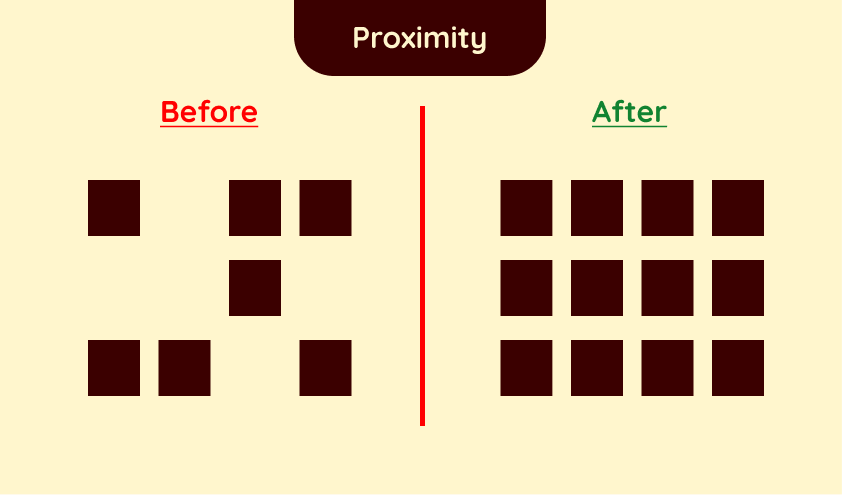
Proximity refers to the grouping of related elements together, creating visual relationships. When elements are placed close to each other, they are perceived as a cohesive unit. Proximity helps to organize information and establish a visual hierarchy within a design. By grouping related elements, designers can enhance readability, reduce clutter, and create a sense of order.
5. Emphasis:
Emphasis involves creating a focal point or center of interest within a design. It helps to draw the viewer's attention to a specific element or message. Emphasis can be achieved through variations in size, color, contrast, or placement. By strategically applying emphasis, designers can guide the viewer's gaze and convey the intended message effectively.

6. Repetition:
Repetition involves the consistent use of visual elements throughout a design. It helps to create a sense of unity and reinforce the overall visual identity. Repetition can be seen in the consistent use of colors, shapes, patterns, or typography. By utilizing repetition, designers can establish a visual rhythm and create a memorable and cohesive design.

7. Simplicity:
Simplicity is the art of eliminating unnecessary elements and reducing complexity. It involves distilling a design into its essential components, ensuring clarity and ease of understanding. Simple designs are often more visually appealing and user-friendly. By embracing simplicity, designers can create elegant and impactful designs that effectively communicate their message.

Conclusion:
Design principles provide a framework for creating visually appealing, harmonious, and engaging designs. By understanding and applying principles such as balance, unity, contrast, proximity, emphasis, repetition, and simplicity, designers can create designs that captivate and communicate effectively. Whether it's in graphic design, architecture, or user interface design, these principles serve as invaluable tools for designers to create impactful and memorable experiences. By continuously exploring and honing their understanding of these principles, designers can push the boundaries of creativity and innovation, shaping the visual world we interact with every day.
Post a Comment